Ghost mode
Vít Krejčí
basketball
I was lying in bed, unable to shake off the feeling that there was simply no point in any of this. I wasn’t getting anywhere. Fuck it.
I was terrible. Absolutely terrible.
Nothing was working for me on the court. Back home in the Czech Republic, I used to score thirty points a game. Here, I felt like this tiny, skinny little tagalong who was just there to make up the numbers. On Zaragoza’s reserve team, I was genuinely the tenth man in the rotation. A complete nobody. Nobody. I was about to turn seventeen, I’d been stuck here for the past three years, and all I’d been doing was training.
But why the hell was I doing this?
Basketball had been my passion since I was a little kid. I’d never wanted to do anything else. But what was the point if I was simply no good?
So I was seeing my family twice a year, losing touch with my friends, sacrificing my entire life up to that point for one single goal—and this was the result? At an age when I should have been making a real name for myself, I was playing for the B team, and I couldn’t even perform there?
I reached for my phone and found the number of my agent, Phillip Parun, in my contacts. All I had to do was press call. I started rehearsing what I was going to tell him and how I was going to say it. How I’d explain that I couldn’t do this anymore. The last six months had been nothing but misery. I wasn’t enjoying basketball at all, and I couldn’t see any chance of things getting better here.
I wanted out. I wanted to go home. I was sick of this. Maybe I simply wasn’t as good as I’d thought.
I placed my finger on the call icon.
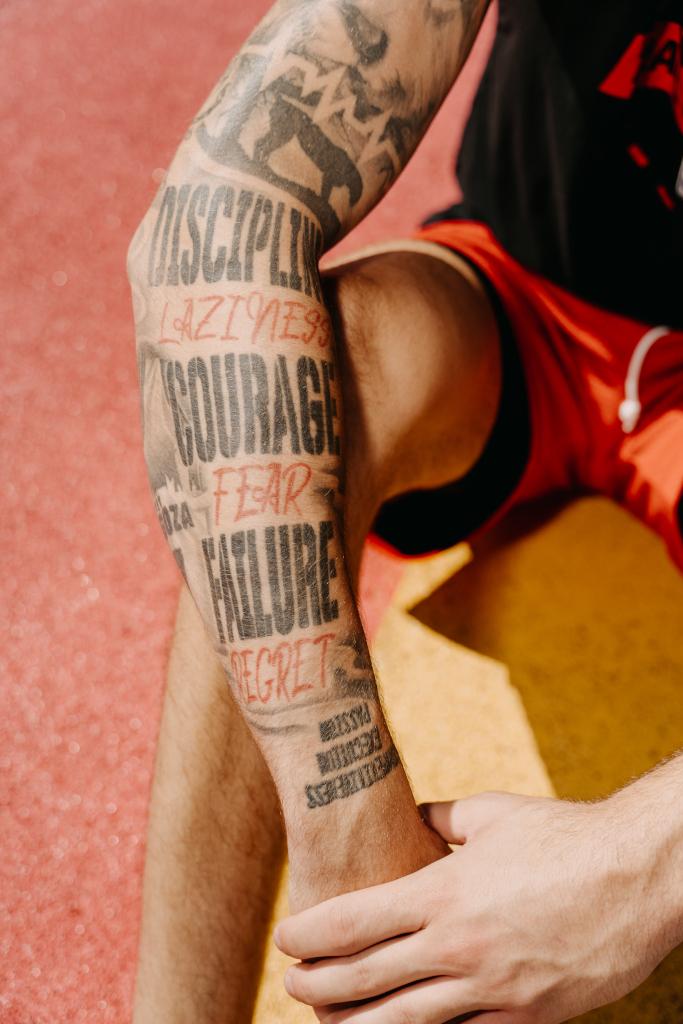
Laziness.
Fear.
Regret.
I have these three words tattooed on my right arm. They represent the things I need to avoid. They’re done in red, so they stand out like a warning, to stop me from even considering letting them take control of me. They’re intertwined with three larger, more prominent words that represent the things I need to succeed. There are three of those, too, including discipline and courage.
Discipline and courage. Those words sum up my entire basketball life.
I first flew to Zaragoza when I was thirteen. It was for a tournament where they wanted to take a look at me. My parents put me on a plane in Prague, telling me that someone would be waiting for me in Barcelona to accompany me by train to the city.
Well, at least everyone understood the plan that way.
The guy who worked for the club did pick me up, but then he simply drove me to the train station and said, “See ya.” He slammed the door shut and drove off.
I was left standing in the middle of this huge sea of people, with nothing but a suitcase and a backpack, and I started to panic. I burst into tears right there. What was I supposed to do now? I didn’t speak a word of Spanish, and the locals weren’t much better at English. I had absolutely no idea what to do next. Even though I knew it would scare my parents, I picked up the phone and called them. They immediately called Phillip and gave him a massive dressing-down. Their thirteen-year-old son had just been left alone in a sea of strangers he couldn’t communicate with because of a misunderstanding.

A little while later, someone from Zaragoza called me back and talked me through finding the right train. It still took me a long time to get over what had happened. My parents did, too, even though they eventually realized that taking the train was perfectly safe and there was nothing to be afraid of.
Even so, when I moved there permanently that summer, my mum stayed with me in Zaragoza for the first six months. She helped me enormously because everything about that first season was new to me. I had to learn everything as I went along and get used to a completely different way of life. I had to understand the local mentality and get used to things like training from seven in the evening until ten at night, because in Spain, pretty much everything happens later. On top of that, I still had to finish elementary school, so I attended a local school where I couldn’t understand a thing. I always sat at the back and did my own thing because I couldn’t follow any of the lessons anyway.
At the same time, I was experiencing the pressure of having to prove myself in basketball for the first time. There weren’t that many kids who had moved to Spain from Czechia at such a young age. I felt I had to show them why I was there and why they had chosen me.
In other words, my childhood had just ended.
Sometimes I look at photos of myself from that time and wonder how my parents could have let me go to Zaragoza at that age. Especially my mum, who worries about everything. But whenever I ask her about it, she tells me that I wanted to go to Spain so badly there was simply no talking me out of it. Apparently, I talked about nothing else. My parents remember constantly trying to come up with reasons why I shouldn’t go and discussing them with me. They weren’t trying to talk me out of it outright; they were just asking whether I’d thought about this or that. They wanted me to understand that it wasn’t going to be easy.
And my answer was always that I could handle it. I was going. End of story.
Courage. Fear.
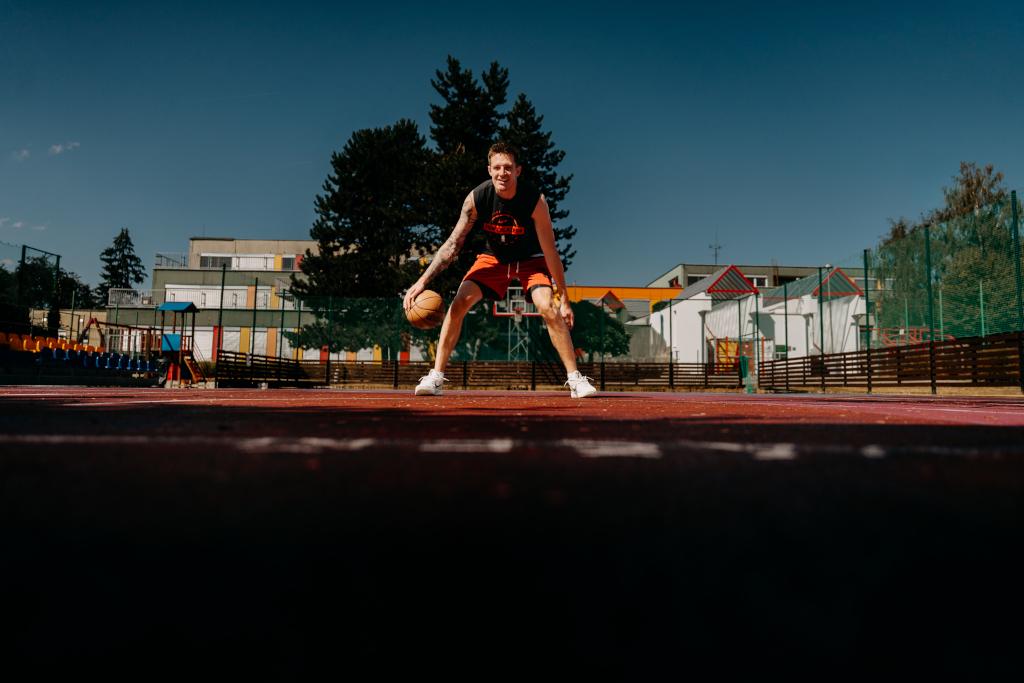
I was excited about the big things waiting for me. I never even considered the possibility that I might go through a rough patch. As soon as the offer from Spain came along, I kept telling myself that I’d have to be stupid not to accept it. I had no idea what it would be like to live without my family and friends.
It only dawned on me later. Only when I experienced firsthand that, at fourteen, I had essentially become a professional basketball player and the rest of life had ceased to exist for me.
It hit me when I messaged my friends back home or scrolled through Instagram and saw all the experiences I was missing out on. All those ordinary things I simply couldn’t be there for. I gradually lost touch with so many people because I saw them only once a year. Maybe twice at the beginning, when I could still go home for Christmas. Otherwise, I had a week off in the summer, because after that it was time for the national youth team. I never turned that down, even when I was brutally exhausted, because at least I got to spend time with guys I’d known since childhood. The Spanish guys were great, but our relationships were different. My home was—and still is—somewhere else.
From the age of fourteen to nineteen, I knew nothing but basketball. If I went out in Zaragoza three times during that period, that was a lot. I had eleven training sessions a week. In the morning, I went to the gym to train. Then back to my apartment to eat and sleep. In the evening, back to the gym. Eat and sleep again. That was my life, every single day. And that’s without even counting the games.
So when someone tells me today that they’re working hard, I tell them what it was like for me. How I went four years without missing a single day of training. That’s discipline. There’s no magic potion or one special exercise that will open the door to the NBA, even though young basketball players would love to hear that there is. At camps, they often ask me exactly that: What do I need to do to get where you’ve managed to get?

Nothing special. It’s just about sticking with it. Maintaining consistency in your effort.
It’s not enough to go all out for a few training sessions, keep it up for a week, maybe a month, and film yourself doing it. It’s about doing something over the long term, without cutting corners. With a conviction that has to come from within you, not from anyone else.
I did it for five years.
Five years, every single day, mate.
One idea from Kobe Bryant’s book helped me enormously with this: “Don’t negotiate with yourself.” If you’ve set yourself a goal and established a routine that will get you there, you can’t start slacking off. No matter what happens. Are you tired? So what? You decided at the beginning that this was what you were going to do, so don’t start saying you want things to be different now. That it’s too much. No.
You want to achieve what you set out to do? Then put in the work. Your body can handle it up to a certain age. Don’t worry. Don’t be afraid.
 Not even when there are temptations all around you. Friends, family, exhaustion… Blah, blah, blah.
Yeah, there were plenty of times when I wanted to skip training, too. I told myself, “It’s just one session…” What difference would missing one session make over five years? Come out for a beer. Take a break. Stay home… But giving in to that kind of thinking is incredibly dangerous. You do it once and tell yourself that nothing happened.
Then you do it a second time.
And suddenly, you realize you’ve reached a point where you’re lying to yourself. It starts snowballing, and you can’t stop it.
Discipline. Laziness.
To prevent that from happening, you need to train your mind so that you don’t miss a single training session. Not even one. You can’t fall into a spiral where you keep letting yourself get distracted over and over again. I told my girlfriend this at the very beginning of our relationship: I wasn’t going to miss a second of basketball, a second of training that could help me improve, just so we could go out to dinner. And she’s amazing about it. She understands. She knows that when I have time to spend with her and our dog, I absolutely love doing so. I also love taking them with me wherever possible. They travel with me so we can stay close. But if I’ve got a training session planned and we want to do something else instead? Sorry, that’s not happening. There’s no way I’m cutting it short or canceling it for anything.
I’ve never told myself that I’ve done enough for the day. I’ve always wanted more. I’ve always thought about what else I could do, where I could put in extra work, how I could improve.
The third positive word tattooed on my forearm, the one that sums up how I got to where I am today, is FAILURE.
Exactly.
However strange that might sound to you. Because failure is actually the best moment to grow stronger on your journey.
Something always goes wrong. You don’t have to be trying to get from the Czech Republic to the NBA, which isn’t exactly a typical path. This applies to anything.
It’s not a question of whether bad moments will come. They always do, sooner or later. What matters is how you react to them. What you take away from them.
 I believe that the more bad experiences you go through, the stronger you become. Even someone who manages to avoid difficult moments will eventually run into one. And then they won’t know how to react.
Not like someone who has already been through something unpleasant and managed to deal with it.
My dad drilled this mindset into me from an early age. He saw potential in me and always believed incredibly strongly that I could make something of myself. He also realized that achieving something big was something I wanted for myself more than anything, so he pushed me hard and challenged me without making me sick of it.
And he knew how to do it intensely.
My older sister found that out, too, when he started coaching her after I left for Spain. She quit basketball after two years because she simply couldn’t handle it. She wasn’t built for dad’s way of pushing, and going through what I did wasn’t worth it to her. And that’s perfectly fine. Everyone is wired differently.
The funny thing is that, after everything I’ve been through, my worst basketball memories are still connected to my dad. For example, when I was around eleven and training with him alone, my little finger hurt like hell. I couldn’t handle the ball properly, so I complained that I’d probably jammed it.
Dad said there was nothing wrong with it. “Go run it under cold water, then finish the session.”
But the pain didn’t go away over the following days. Eventually, during a game, I fell on the same hand, and the pain was so intense that even dad agreed to take me for an X-ray. It revealed that I had a fracture on the little-finger side of my hand—and that I’d actually broken it two weeks earlier.
“See? I wasn’t faking it,” I told dad, who just grumbled something in response.
I was supposed to wear the cast for two weeks, but he had it cut off after just one because we had the Czech national championships coming up. It still hurt unbelievably badly, but he knew I could handle it and that the experience would make me a little more resilient.
He’s a soldier. That kind of attitude is part of who he is. He also used to play and coach basketball himself. He knew what was possible and where the limits were.
 Back then, I often resented him for putting me through so much. He drove me mad. But today, I’m grateful that he deliberately exposed me to uncomfortable situations and awakened in me the desire to fight my way through them.
Man, how I hated it when he walked away from the stands…
At our home arena in Písek, he always started right down at the bottom, behind the bench. But if he thought I wasn’t playing well, he would gradually move farther and farther away toward the exit. That hurt me more than anything. I’d keep glancing over from the court to see if he was watching. The moment he lost interest and started heading toward the stairs leading to the parking lot, I was crushed.
Once—I must have been about eleven—I made a stupid turnover. I looked over, and dad was already somewhere around the tenth row. A little later, I messed something else up, and he was standing by the exit. Then I committed an unnecessary foul, looked at him, and he just shook his head and walked out.
Awful.
At the same time, though, it gave me extra motivation to become better. He knew he could provoke me like that and that it would have the right effect. He knew I wouldn’t give up.
He also knew how to support me when I thought I’d played badly and he came over and patted me on the back. He could sense when I needed a kick up the backside and when I needed encouragement. He was good at that, even though he often drove me crazy. He prepared me brilliantly for what basketball would bring me in the years that followed.


Join the Club
Inspiring stories told by elite athletes.
\
Vít Krejčí
most points in NBA game for Czech player (28)